


All You Need to Know About Sheet Metal Flame Correction

Estimated reading time: 12 minutes
In the thermal correction of sheet metal, the most widely used is the oxyacetylene flame correction. Flame correction is not only used in the preparation of materials but also can be used to correct the deformation of the structure in the manufacturing process. Because the flame correction is convenient and flexible, the cost is low, so it is used widely.
Physical properties of sheet metal materials have heat bilges cold shrink, when local heating, heated material is heated and inflation, but due to the low temperature surrounding materials, therefore impeded, the heating of metal by the compressive stress, when the heating temperature is 600 – 700 ℃, the compression stress exceeds the yield strength of the material at the temperature, produce compression deformation. When the heating is stopped, the metal cools and shortens. As a result, the metal fibers at the heating point are shorter than the original ones, creating a new deformation. Flame correction is to correct the original deformation by using the new deformation caused by the local heating of metal. Therefore, it is the key to master the flame correction to understand the deformation law caused by the local heating of the flame.
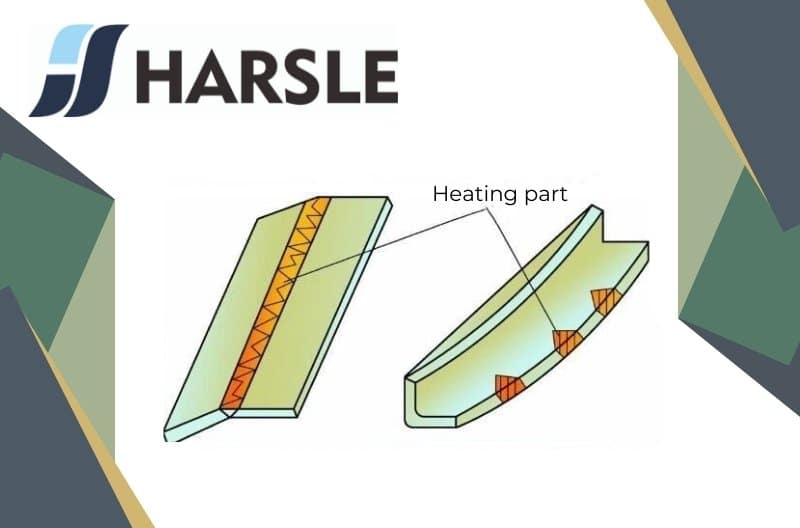
The following picture shows the deformation of steel plate, Angle steel, and T-steel during and after heating. Because the metal fiber in the heating area should be shortened after cooling, the section steel is bent and deformed toward the heating side.
In the flame correction, the deformation caused by heating must be in the opposite direction to the original deformation in order to offset the original deformation and be corrected.
The heat source of flame correction heating is usually oxygen-acetylene flame,because the temperature of the oxygen-B fast flame is high and the heating speed is fast.

Operation Method of Flame Correction
Flame correction is a manual operation, must be based on the deformation of the workpiece, control the flame heating position, time, temperature, and other aspects to obtain a better correction effect. Different heating positions can correct the deformation in different directions, and the heating position should be selected in the longer part of the metal fiber, that is, the outside of the bending deformation of the material. In addition, the shape of the heating area on the heated workpiece has a great influence on the direction and amount of deformation of the corrected workpiece, and the direction of the largest fiber length difference through the heating area on the corrected workpiece in the direction of the largest bending deformation of the workpiece.
The amount of deformation is proportional to the length difference across the heating zone. With different flame heat, you can get different abilities to correct deformation. If the heat of the flame is insufficient, the heating time will be extended, the heating range will be expanded, and the deformation difference between parallel fibers will be reduced, so it is not easy to straighten, so the faster the heating speed, the more concentrated the heat, the stronger the correction ability, and the greater the amount of correction deformation.
When low carbon steel and ordinary low alloy steel flame correction, the heating temperature of 600-80℃ is often used. The general heating temperature should not exceed 850℃, so as not to overheat the metal when heating, but the heating temperature can not be too low, because the correction efficiency is not high when the temperature is too low. The heating temperature can be roughly judged according to the color of the heated surface of the steel in production, and its accuracy is related to experience, as shown in the table.
| Colour | Temperature /℃ | Colour | Temperature /℃ |
| Dark maroon | 550-580 | Bright fuchsia | 830-900 |
| Maroon | 580-650 | Orange | 900-1050 |
| Dark fuchsia | 650-730 | Dark yellow | 1050-1150 |
| Deep fuchsia | 730-770 | Bright yellow | 1150-1250 |
| Fuchsia | 770-800 | White yellow | 1250-1300 |
| Light fuchsia | 800-830 |
The heating methods on the surface of the deformed workpiece are spot heating, linear heating and triangle heating.
Spot heating refers to the point where the heating area is a circular area of a certain diameter. According to the deformation of steel to determine the distribution of hot spots and hot spots number. Multi-spot heating is commonly used in plum types (see picture a). The diameter of each point d should be appropriately larger when heating the thick plate, and the thin plate should be smaller, which should not be less than 15mm in general.

The larger the deformation, the smaller the distance between the points a, generally 50-100mm heating flame moves along the straight direction or at the same time in the width direction of a certain transverse lift, called linear heating (see picture b). It has direct heating, chain heating, and strip heating 3 kinds. The transverse shrinkage of the hot wire is generally greater than the longitudinal shrinkage, and the amount of shrinkage increases with the increase of the width of the hot wire. The width of the hot wire is generally 0.5-2 times the thickness of the steel. Linear heating is generally used for structures with large deformation.
Where the heating area is triangular, it is called triangular heating (see picture c). Because the heating area is large, so the amount of shrinkage is large, and because the heating width along the height of the triangle direction is not equal, so the amount of shrinkage is not equal, so the bending deformation is also large, often used in the bending deformation correction of members with greater stiffness and larger deformation.
The following table shows common methods of acetylene flame correction for steel.
| Blank | Original deformation | Heating method | Picture | Description |
Thin steel plate (thickness not greater than 8mm) | Middle bulge | Spot heating |  | With the convex part facing upwards, use kama nails. The heating point distance is 50-100mm, and the deformation amount is a small value. The diameter of the heating spot is Φ≥15mm, and the plate thickness is the larger value. Points: The larger the deformation area is, the larger the point is. The heating sequence is shown in the figure, supplemented by hammering |
Thin steel plate (thickness not greater than 8mm) | Middle bulge | Linear heating |  | The convex part faces upward and is stuck on the platform. There are three types of heating line tracks: straight line, wavy line, and spiral line. The width of the latter two is (0.5-2)t. The longitudinal shrinkage along the heating line is smaller than the transverse shrinkage. When the amount of deformation is large, the line width can be increased, and the line spacing can be reduced |
| Thin steel plate (thickness not greater than 8mm) | Wavy on one side | Linear heating |  | With the convex part facing upwards, clamp the three undeformed sides, first heat both sides of the convex part, and then surround the convex part to repeat heating |
Thick steel plate | Arch bend | Linear heating |  | Put it on the platform and heat it from the highest point to 600-800℃, the heating depth does not exceed 1/3 of the thickness of the plate, and it can be heated repeatedly |
Steel Pipe | Bend | Spot heating |  | Heating convex surface (single row of dots or multiple rows of dots), the speed from point to point should be fast, heating row by row |
| T-shaped steel | Side bend | Triangle heating |  | Heat the bulging part of the horizontal plate |
| T-shaped steel | Side bend | Triangle heating |  | Heating the bulging part of the vertical plate |
| Angle steel | External bend | Triangle heating |  | Heating the raised area |
| I-beam | Side bend | Triangle heating |  | Heating the raised area |
| Channel steel | Partial side bend | Linear heating |  | Two welding torches are heated in a wave shape at the same time |
| Steel cylinder | Local curvature is too large | Linear heating |  | Heating along busbar |
| Steel cylinder | Local curvature is too small | Linear heating |  | Heating along busbar |
Precautions for Flame Correction Operation
- The heating speed should be fast, the heat should be concentrated, and the heating range outside the heating area should be narrowed to the best of our ability. T-sample can improve the correction effect and obtain a larger local contraction. When correcting the large deformation area, no matter using multi-spot or multi-line heating, the heating area is forbidden to overlap, otherwise, it will damage the workpiece material. Before the correction, spots, lines, and running directions of batch heating should be delimited according to the size of the deformation area and the degree of deformation. All points and lines in the same batch shall be distributed in a spaced, symmetrical and leaping manner within the whole area. The whole heating process should be carried out in batches. When a batch meets the correction requirements, there is no need to carry out the next batch of heating. Correction process without general arrangement shall be prohibited. This can not only ensure the correction effect but also avoid the phenomenon of heating area overlap. The sequence of hot spots and line positions of each batch of sand must start from the edge of the deformed area. Excessive centralized heating in the middle of the deformed area is prohibited. Otherwise, excessive deformation in the deformed area will be caused and subsequent correction will be difficult due to the village quality of the area.
- In the actual correction work, often after heating water to quench the heating area, in order to accelerate the metal contraction, improve the correction efficiency. Compared with the simple flame correction, the effect can be increased more than times, the method is also known as the water and fire correction method. The water and fire correction method has certain limitations, when the correct thickness is 2mm of low carbon steel plate, the heating temperature is generally not more than 600℃, at this time the distance between water and fire should be closer. When the correct thickness is 4~6mm steel plate, the heating temperature should be 600-800℃, the distance between water and fire is 25-30mm. Correcting steel plates with thicknesses greater than 8mm, water cooling is generally not considered because water cooling will cause greater stress. When correcting steel plates that have a tendency to harden (such as ordinary low alloy steel plates), the distance between water and fire should be larger. For the material with a large tendency to harden (such as medium and high carbon steel or alloy steel), water and fire correction methods cannot be adopted, and only a certain degree of air cooling can be carried out to strengthen its deformation degree. When correcting the bending of the steel plate, the heating depth should be controlled in 1/4~1/3 of the thickness of the plate. It should not be too deep, otherwise, it will greatly affect the effect of flame correction.
- Although flame correction is a more significant correction method, it is still poor in the control ability of the amount of correction deformation, especially for the workpiece which is particularly sensitive to the effect of flame correction, such as the straightening of slender parts and the straightening of thin plate parts. Therefore, for the correction of large deformation of this kind of workpiece, flame correction can only be used as a rough correction method, and should be matched with the subsequent mechanical correction; Flame correction should not be used for the correction of such workpiece with small deformation and higher requirements, otherwise, it will lead to new or even larger deformation.
- In order to accelerate the contraction of the heating zone, there are often supplemented by a hammer, but to use a wooden hammer or copper hammer, not the hammer.

what’s the price of the shearing machine